Built on Verified Science and Proven Community Economics
The Hermes Project does not operate on theory alone. Every module — from biometric coherence monitoring to sovereign token architecture — is informed by the published research of the HeartMath Institute and the community economics framework pioneered by Michael Tellinger through UBUNTU Contributionism and One Small Town.
These are not advisors or endorsers. They are the scientific and philosophical substrate on which this blueprint is engineered. What follows is a direct account of their work, its relevance, and how it is applied within The Hermes Project's operational framework.
Pillar One: HeartMath Institute
The HeartMath Institute is a globally recognized research organization with over three decades of peer-reviewed science on heart-brain coherence, heart rate variability (HRV), and the measurable psychophysiological effects of emotional regulation. Their work demonstrates that coherent HRV states — achieved through intentional breathing, emotional focus, and community resonance practices — produce quantifiable improvements in cognitive clarity, immune function, and social cooperation.

Within The Hermes Project, HeartMath's HRV coherence science is the direct scientific basis for Module 02: Wearable Resonance Interface. Biometric data collected at the local node level — never uploaded to centralized servers — is processed against HeartMath coherence benchmarks. The result is a community wellbeing metric that is objective, private, and tied to real physiological outcomes, not self-reported surveys.
HRV coherence data also informs the Live Dashboard's bioresonance coherence readings — one of four real-time telemetry streams that constitute the proof-of-concept layer of this infrastructure. The inclusion of HeartMath methodology ensures that sovereign community wellbeing is measured with the same rigor applied to soil carbon and thermal capture.
Pillar Two: UBUNTU Contributionism / One Small Town
Michael Tellinger is a South African author, researcher, and founder of the UBUNTU Contributionism movement — a community economics framework grounded in the principle that each person contributes a small portion of their skills and time to the community, and the community in turn provides for all its members. UBUNTU Contributionism is not utopian philosophy; it has been operationalized through the One Small Town initiative, a structured rollout model being implemented in communities across multiple countries.
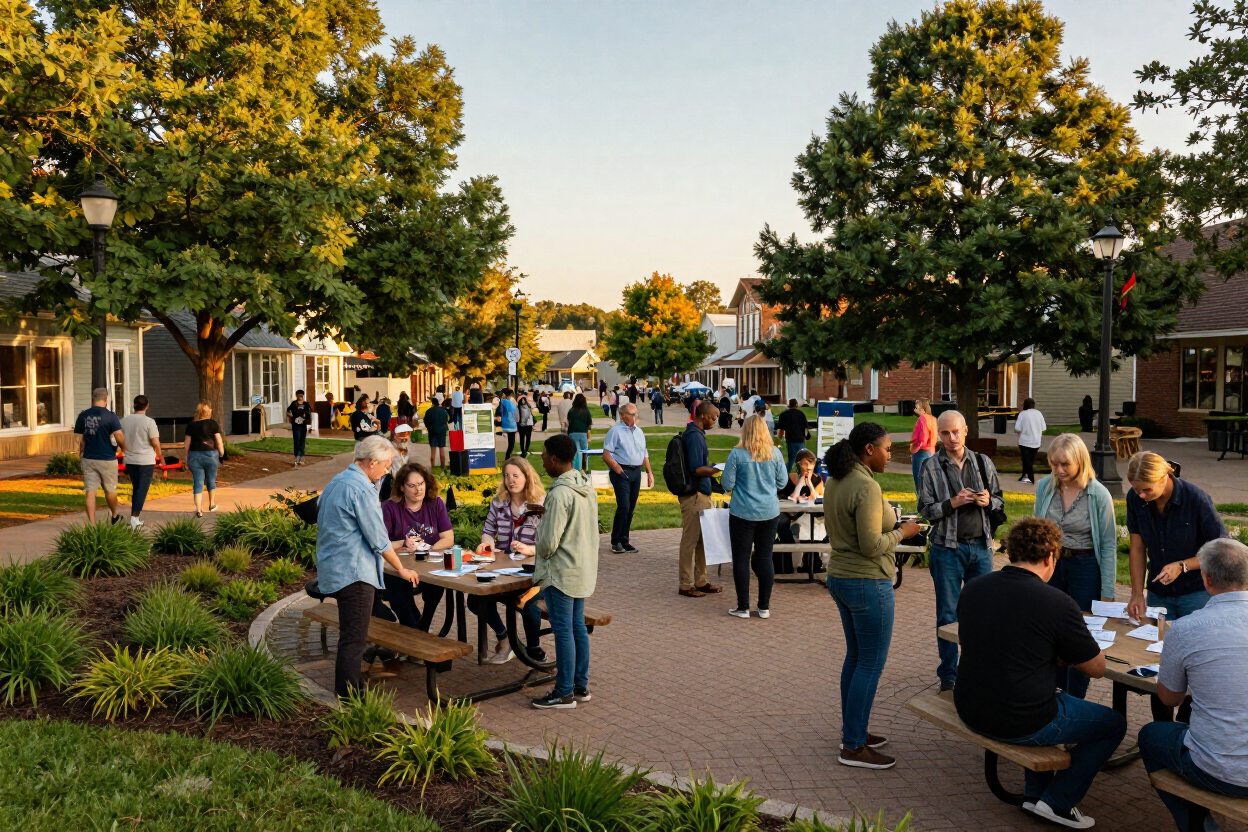
One Small Town operationalizes the contributionist model at the municipal scale: community members contribute one hour of their professional skills per week to collectively owned community enterprises. The surplus generated is redistributed across participating households, progressively reducing financial dependency on external employment and debt-based monetary systems. The model is designed to run inside existing legal and economic frameworks without requiring a break from conventional society.
Within The Hermes Project, the UBUNTU Contributionism framework directly informs Module 03: Sovereign Token Architecture — specifically the design of contributionist income streams and community treasury logic — and Module 04: Intent-Based Ledger, where the foundational governance principle ('harm no biological system') is operationalized as a protocol constraint. The One Small Town rollout model also provides the tested community onboarding methodology that informs The Hermes Project's engagement pathways.
The Law That Governs This Infrastructure
Science and community economics establish what is possible. The legal architecture establishes how it is protected. The Charter outlines the three-layer sovereign legal structure — Passive Natural Trust, Private Member Association, and Micro-Nation — that operationalizes these principles as binding, ink-signed covenant, not digital policy.